
- About Us
- Fertility Treatments
- Fertility Testing & Info
Call Us
- Fertility Testing
- Causes of Male Infertility
- Causes of Female Infertility
- Diminished Ovarian Reserve
- Womb and Fallopian Tubes: Causes of Female Infertility
- Amenorrhoea and Oligomenorrhea
- Endometriosis
- Ovarian Cysts
- Premature Ovarian Failure
- Polycystic Ovary Syndrome
- Blocked Fallopian Tubes
- Endometrium
- Uterine Fibroids and Fertility
- Uterine Malformations
- Asherman’s Syndrome
- Infertility Caused by Medication
- Repeated Miscarriages
- Price List
- Contact Us
Intracytoplasmic Sperm Injection (ICSI)
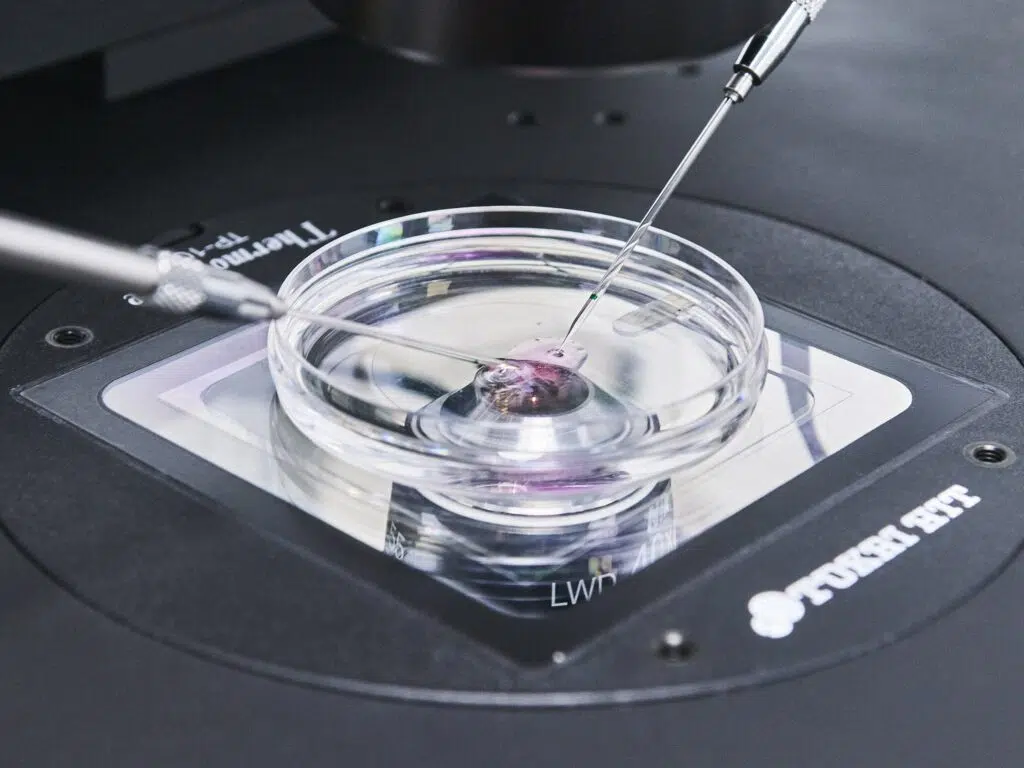
Intracytoplasmic Sperm Injection (ICSI) Treatment
Intracytoplasmic Sperm Injection (ICSI) is a specialised form of IVF that can help when fertilisation is less likely to occur naturally. During treatment, a single sperm is carefully selected and injected directly into an egg, helping to overcome barriers that may prevent the sperm from reaching or penetrating the egg’s protective outer layer, known as the zona pellucida.
ICSI is commonly recommended for people experiencing male factor infertility, previous fertilisation difficulties, or other circumstances where conventional IVF may be less effective. Once fertilisation has taken place, the remainder of the treatment process follows the same stages as a standard IVF cycle.
Understanding ICSI vs IVF: What is the Difference?
ICSI and conventional IVF follow the same treatment process, but differ in how fertilisation occurs. Conventional IVF relies on sperm fertilising the egg naturally in the laboratory, whereas ICSI involves the direct injection of a single sperm into the egg.
| Conventional IVF | ICSI |
| Eggs and sperm are combined in a laboratory dish. | A single sperm is injected directly into each mature egg. |
| Fertilisation occurs when a sperm naturally penetrates the egg’s outer layer (zona pellucida). | Fertilisation is assisted by bypassing the zona pellucida through precise microinjection. |
| Relies on sperm reaching and fertilising the egg independently. | Removes the need for the sperm to travel through or penetrate the egg on its own. |
| Suitable for many patients where sperm function is not a significant concern. | Often recommended for male factor infertility or previous fertilisation difficulties. |
| Multiple sperm surround the egg during fertilisation. | Only one selected sperm is introduced to the egg. |
| Small risk of abnormal fertilisation from more than one sperm entering the egg (polyspermy). | The use of a single sperm helps minimise the risk of polyspermy. |
| Fertilisation depends on natural sperm-egg interaction. | Fertilisation is supported through direct laboratory intervention. |
Whether IVF or ICSI is recommended will depend on your individual fertility circumstances. Our specialists will assess factors such as sperm quality, previous treatment outcomes, and your overall fertility profile to determine the most appropriate treatment approach.
Book an ICSI Fertility Consultation With A Specialist
Medical Indications for an ICSI Procedure
ICSI may be recommended when there is a reduced chance of fertilisation occurring through conventional IVF. This is most commonly due to male factor infertility, including:
- Oligozoospermia (low sperm count)
- Asthenozoospermia (reduced sperm motility)
- Teratozoospermia (abnormal sperm morphology)
- The use of surgically retrieved sperm
ICSI may also be advised following low or failed fertilisation in a previous IVF cycle, in some cases of unexplained infertility, or when treatment involves previously frozen eggs (cryopreservation).
While a recommendation is often made in advance, our embryology team will always make a final assessment on the day to ensure the most appropriate approach for your treatment.
Surgical Sperm Retrieval Options for Severe Azoospermia
Even when no sperm are present in the ejaculate, known as azoospermia, ICSI may still be possible. In some cases, viable sperm can be collected directly from the testicular tissue using minor surgical procedures such as Testicular Sperm Aspiration (TESA) or Microdissection Testicular Sperm Extraction (Micro-TESE). Any sperm retrieved can then be used during ICSI, helping some men with severe male infertility achieve fertilisation and pregnancy.
The Step-by-Step ICSI Cycle Timeline
Every treatment plan is tailored to you, but a typical ICSI cycle includes:
-
Ovarian Stimulation
Medication is used to encourage the development of multiple eggs.
-
Egg Collection
A short, minimally invasive procedure is performed to collect the eggs.
-
Sperm Collection
A sperm sample is provided by a partner or donor on the same day.
-
ICSI Procedure
A single sperm is gently injected into each mature egg.
-
Embryo Development
Embryos are carefully cultured and closely monitored in the laboratory over several days, typically up to five days, to support their development.
-
Embryo Transfer
A selected embryo is placed into the uterus in a simple procedure.
-
Pregnancy Test
Around two weeks later, a test confirms whether implantation has occurred.
Additional Sperm Selection: PICSI & Zymot
In some cases, additional sperm selection techniques may be recommended alongside ICSI to help identify sperm with the best potential for fertilisation and embryo development.
PICSI (Physiological ICSI) uses a specialised dish containing hyaluronan, a substance naturally found around the egg. Mature sperm that are able to bind to the hyaluronan are selected for injection, as these sperm are thought to have better maturity and DNA integrity.
Zymot Sperm Separation is a sperm preparation method that uses a gentle microfluidic device to help select highly motile sperm with lower levels of DNA fragmentation. Unlike traditional sperm preparation techniques, Zymot avoids centrifugation, which may reduce oxidative stress on sperm cells.
These additional techniques may be particularly helpful in cases of male factor infertility, previous poor fertilisation, recurrent IVF failure, recurrent miscarriage, or elevated sperm DNA fragmentation. Your consultant or embryologist will advise whether either option may be beneficial for your treatment.
Clinical Outcomes and ICSI Success Rates
ICSI is highly effective at supporting fertilisation in the laboratory, with fertilisation rates often around 70-80% per mature egg. However, this does not guarantee pregnancy or live birth. Final ICSI success rates depend on several individual factors, including age, maternal reproductive health, sperm quality, egg quality, and how well embryos develop after fertilisation.
Overall, live birth rates following ICSI are generally comparable to conventional IVF when used for the right clinical indications.
The ICSI Technique: Laboratory Micromanipulation
ICSI (Intracytoplasmic Sperm Injection) is a highly specialised laboratory procedure performed by experienced embryologists using advanced micromanipulation equipment.
During the procedure, the embryologist carefully selects a single healthy-looking sperm based on its shape and movement. The sperm is immobilised by gently touching or breaking the tail, which stops it from moving and prepares it for injection. The sperm is then drawn into an extremely fine glass needle.
The mature egg is held securely in place using a holding pipette while the embryologist carefully injects the single sperm directly into the centre of the egg. This process bypasses many of the natural barriers to fertilisation and can be particularly effective when sperm numbers, movement, or quality are reduced.
Following the procedure, the eggs are returned to carefully controlled incubators. The embryology team then checks for signs of successful fertilisation the following day, before monitoring embryo development over the days that follow.
Individualised Treatment Planning and Costs
ICSI is provided as an additional laboratory procedure within an IVF treatment cycle. The cost of treatment will depend on your individual circumstances and whether ICSI is recommended as part of your fertility plan. For a detailed breakdown of fees, please visit our pricing page or speak to our team.
If you are considering ICSI treatment, we encourage you to book a consultation with one of our fertility specialists. We’ll take the time to understand your fertility history, discuss your treatment options, and create a personalised plan designed around your needs, helping you move forward with confidence and clarity.
Book an ICSI Fertility Consultation Today