
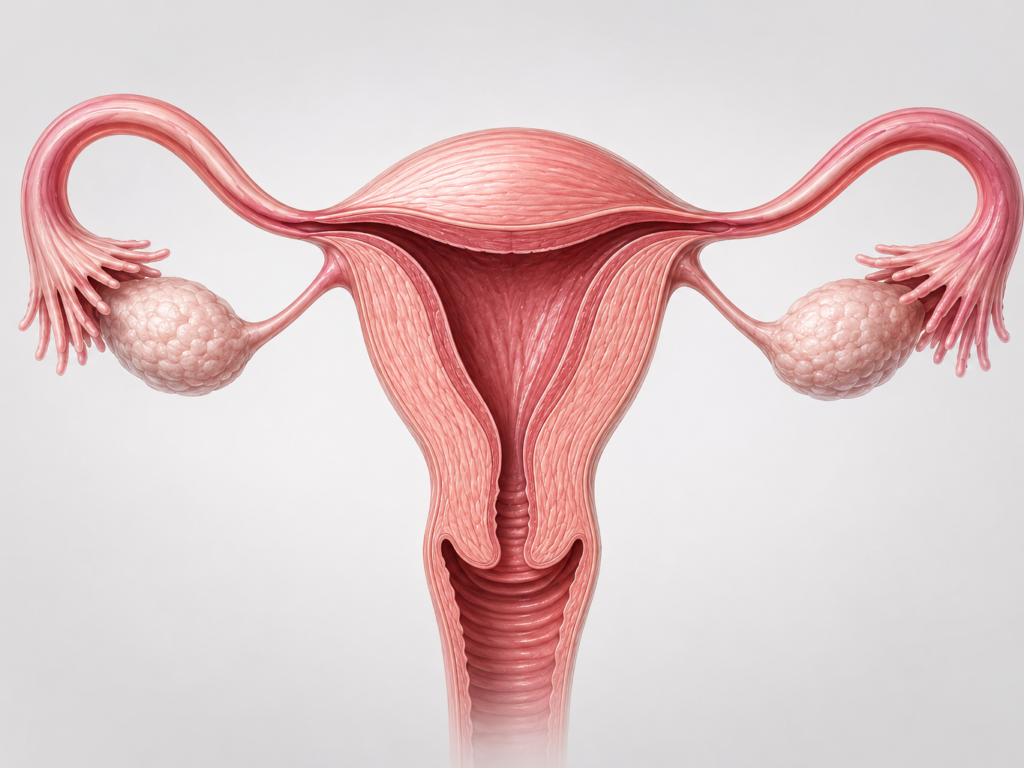
Womb and Fallopian Tubes: Causes of Female Infertility
For a natural pregnancy to happen, your womb and fallopian tubes both play a role.
Each month, an egg is released from an ovary and travels along a fallopian tube, where it may meet and be fertilised by sperm. The resulting embryo then moves into the womb (uterus) and settles into its lining to grow. When something disrupts this journey, whether in the tubes or in the womb itself, conceiving can become more difficult.
Problems affecting the fallopian tubes or womb are among the more common causes of female infertility. The good news is that many of them can be diagnosed and treated successfully.
We explain the conditions that can affect this part of your reproductive system, how they are found, and the options available to help you move forward.
At a glance:
| Issue | Affected Area(s) | Reasoning |
| Blocked tubes and fluid (hydrosalpinx) | Fallopian tubes | Stops egg and sperm meeting; trapped fluid can reduce IVF success |
| Chlamydia and pelvic inflammatory disease | Fallopian tubes | Infection causes scarring that blocks the tubes and raises ectopic risk |
| Sterilisation | Fallopian tubes | Deliberately blocks the tubes; reversal is not always successful |
| Endometriosis | Tubes, ovaries and womb lining | Adhesions, inflammation and effects on egg quality and implantation |
| Uterine abnormalities | Womb | An unusually shaped or scarred womb can affect implantation and pregnancy |
| Fibroids | Womb | Depending on size and position, can interfere with implantation |
Understanding How the Womb and Fallopian Tubes Work
Understanding how conception works makes it easier to see where things can go wrong.
Around the middle of your cycle, one of your ovaries releases an egg. The nearest fallopian tube catches the egg and gently moves it along, and it is inside the tube that fertilisation usually takes place if sperm are present. Over the next few days, the fertilised egg travels down into the womb.
While this is happening, the lining of your womb, called the endometrium, thickens and prepares to receive the embryo. If the timing and conditions are right, the embryo implants into this lining and a pregnancy begins.
Because every stage depends on the one before it, a problem anywhere along this journey can impact your fertility and the possibility of pregnancy. A blocked tube can stop the egg and sperm from meeting, scarring or fluid can create a hostile environment, and changes within the womb can make it harder for an embryo to implant and grow.
The sections below look at each of these in turn.
Common Fallopian Tube Issues
The fallopian tubes are delicate structures, and even small amounts of damage or scarring can affect how well they work. These are the most common tubal conditions we see.
Blocked Tubes and Fluid Accumulation
When a fallopian tube is blocked, the egg and sperm are physically prevented from meeting, so fertilisation cannot take place in that tube. If both tubes are affected, natural conception becomes unlikely.
A blockage can also cause fluid to build up inside the tube, a condition known as hydrosalpinx. In other words, the damaged tube fills with fluid that has nowhere to go. This trapped fluid can also leak back into the womb, where research suggests it may interfere with an embryo trying to implant and can lower the success of in vitro fertilisation (IVF).
For this reason, if you have a hydrosalpinx, your specialist may recommend removing, blocking, or draining the affected tube before starting IVF. Because IVF places embryos directly into the womb, it does not rely on your tubes being open, which means blocked tubes aren’t necessarily the end of your fertility journey.
Chlamydia and Pelvic Inflammatory Disease (PID)
Some tubal damage is caused by infection. Chlamydia is the most common bacterial sexually transmitted infection (STI) in the UK, and as there are often no symptoms, many people do not realise they have, or have had it.
Left untreated, chlamydia can lead to pelvic inflammatory disease (PID), an infection of the upper reproductive organs. PID is one of the main ways infection harms fertility, because the inflammation it causes can leave scarring inside the fallopian tubes. Even after the infection itself has cleared, this scarring can remain and stop an egg from moving freely into the womb.
Scarred or partially blocked tubes also carry a higher risk of ectopic pregnancy, where an embryo begins to grow inside the tube rather than the womb. If you have ever had chlamydia or PID, it is worth mentioning to your specialist, as a simple test can check whether your tubes have been affected.
Sterilisation and Tubal Reversal
If you have previously been sterilised and would now like to conceive, it may still be possible. Sterilisation can sometimes be reversed with an operation to rejoin the tubes.
Reversal is not always successful, however, and even when the tubes are reconnected they can remain partially blocked, which raises the risk of ectopic pregnancy. Because of this, many people choose IVF instead, as it bypasses the tubes altogether.
Uterine Conditions and Structural Abnormalities
Even when the fallopian tubes are healthy, conditions affecting the womb itself can make it harder to conceive or to carry a pregnancy. These range from tissue disorders to differences in the shape of the womb and non-cancerous growths.
Endometriosis and Endometrial Health
Endometriosis is a condition where tissue similar to the lining of the womb grows in other places, such as around the ovaries and fallopian tubes. It is thought to contribute to some cases of otherwise unexplained infertility, although its impact on fertility is still being researched.
Endometriosis may affect your chances of conceiving in several ways. It can cause adhesions, bands of scar-like tissue, that distort or block the fallopian tubes. It may also affect the health of the endometrium and the quality of your eggs, or create inflammation that makes implantation more difficult.
If you have endometriosis, or suspect you might, a fertility assessment can help clarify whether and how it is affecting you, so that your treatment can be tailored accordingly.
Congenital Uterine Wall Abnormalities
Some women are born with a womb that has formed in a slightly different shape. These congenital abnormalities are often only discovered during fertility investigations, and their effect on pregnancy varies.
An embryo needs to implant on a healthy area of the womb lining to grow well. Problems can also arise from scarring or adhesions following previous surgery or miscarriage, or alongside conditions such as diabetes, epilepsy, thyroid disorders, and pelvic or bowel disease.
Two of the more common structural differences are a uterine septum and a bicornuate uterus. They are easy to confuse but behave quite differently, as the table below shows.
| Uterine Septum | Bicornuate Uterus | |
| What it is | A wall of tissue divides the inside of the womb, while the outer shape stays normal. It happens when the dividing tissue present in early development does not fully break down. | The womb forms in a heart shape because the two halves did not fully join together as it developed. |
| Main Effect on Fertility | Most associated with recurrent miscarriage and, in some cases, difficulty with implantation. | More often linked to complications later in pregnancy, such as premature birth, than to difficulty conceiving. |
| How it is Diagnosed | Detailed (3D) ultrasound, MRI, or an investigative look inside the womb. | Detailed (3D) ultrasound or MRI, which reveal the outer shape of the womb. |
| Treatment | Often corrected with a minor procedure carried out through the cervix. | May not need treatment, but surgery is considered in specific cases. |
Fibroids
Fibroids are non-cancerous growths that develop in or around the womb. They are very common and vary widely: you might have a single fibroid or several, and they can be tiny or quite large.
Their effect on fertility depends mainly on their size and position. Some fibroids, particularly those growing inside the womb, can interfere with implantation or block a tube, while others cause no problems at all.
Where a fibroid is thought to be affecting your fertility, it can be surgically removed in a procedure called a myomectomy, which takes out the uterine fibroid while leaving the womb intact.
How to Diagnose Blocked Tubes and Uterine Conditions
So, how do you find out what is causing the problem? A few straightforward tests can check whether your tubes are open and whether your womb has formed and is working normally.
- An ultrasound scan gives a clear picture of your womb and ovaries and can identify fibroids or structural differences.
- To check the fallopian tubes specifically, a dye or contrast test can be used to check whether they are open and identify any potential blockages. One of the most common tests is a HyCoSy (hysterosalpingo-contrast sonography), a gentle, ultrasound-based procedure that uses contrast to examine the tubes without the need for X-rays.
Knowing exactly what you are dealing with means your care can be planned around your situation from the very start.
Treatment Options for Blocked Tubes and Uterine Issues
Once your tests are complete, your specialist will talk you through your options. Broadly, these fall into two approaches: correcting the problem surgically, or working around it.
Surgery can be helpful in certain situations. Keyhole surgery (laparoscopy) can remove adhesions, help treat endometriosis, or open blocked tubes, and a septum or fibroid can be corrected with the procedures described above. Where a tube is filled with fluid, removing it (a salpingectomy) before IVF can improve your chances of success.
However, for many people, IVF offers the most direct route to pregnancy. Because it brings egg and sperm together in the laboratory and places the resulting embryo straight into the womb, it bypasses fallopian tubes — and any underlying issues.
Book Your Fertility Assessment
Finding out that something may be affecting your fertility can feel daunting, but a clear diagnosis is often the first real step towards a solution. Whatever is behind your tubal or uterine concerns, there are usually options, and you do not have to work them out alone.
At Concept Fertility Clinic in south west London, our specialists will investigate what is happening and create a plan built around you.
When you are ready, you can book a consultation online or call our patient services team on 020 3388 3000. We are here to help you take the next step, whenever you feel ready.